G Major Scale
Reviewed for accuracy · Last updated June 2026 · Maintained by Justin Evans
Practice G Major Scale
Reading about it is one thing. Drilling it is what makes it automatic.
Introduction
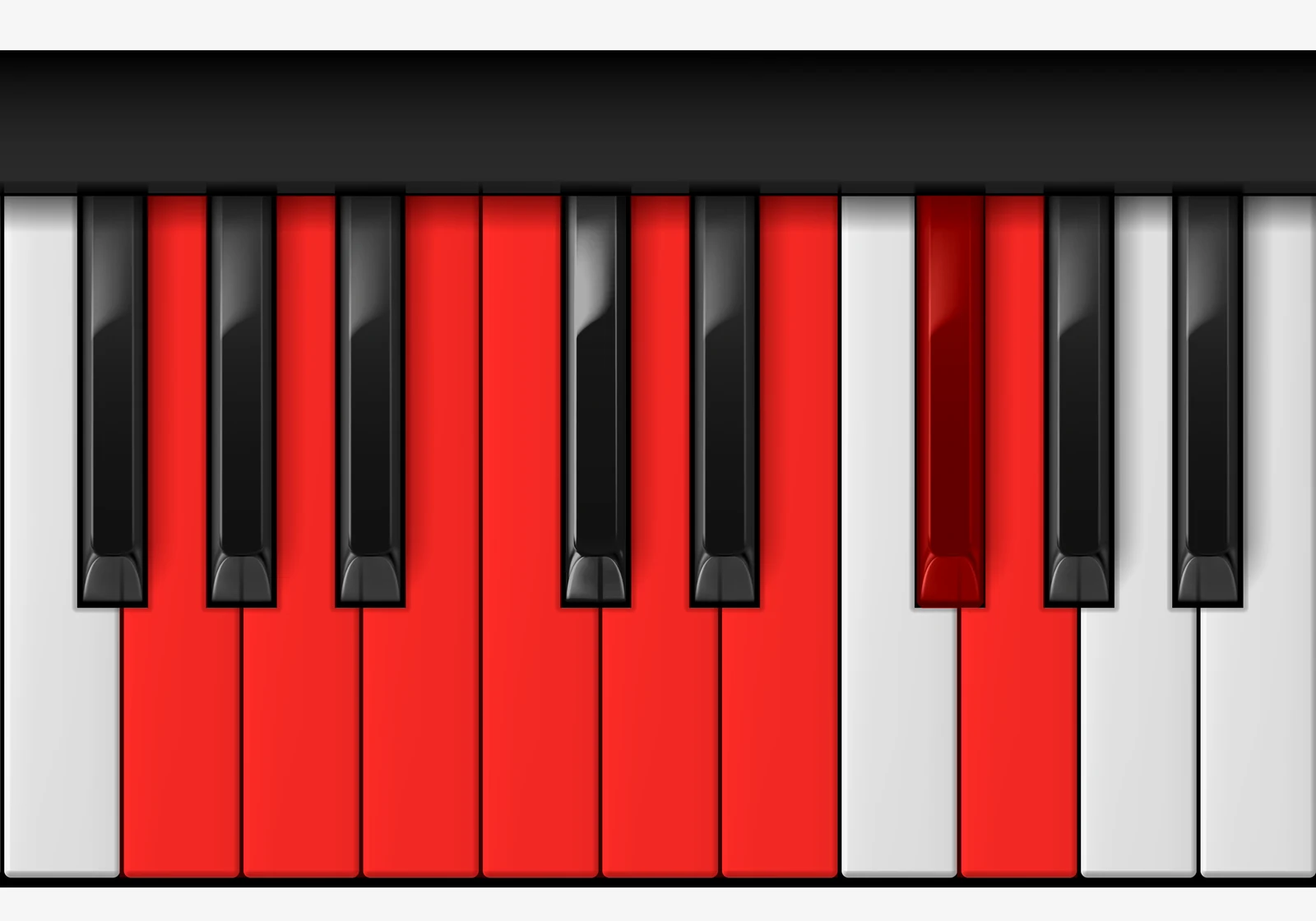
The G Major scale contains seven notes: G, A, B, C, D, E, and F♯. It follows the whole-step / half-step pattern W-W-H-W-W-W-H.
G Major Scale Notes
| Degree | Name | Note | Interval |
|---|---|---|---|
| 1 | Tonic | G | P1 |
| 2 | Supertonic | A | M2 |
| 3 | Mediant | B | M3 |
| 4 | Subdominant | C | P4 |
| 5 | Dominant | D | P5 |
| 6 | Submediant | E | M6 |
| 7 | Leading Tone | F♯ | M7 |
| 8 | Octave | G | P8 |
How to Play the G Major Scale
Practice the G Major Scale hands separately at a slow, steady tempo before putting them together. Aim for even rhythm and a relaxed wrist — the goal is a smooth, connected line where every note sounds the same length and volume. Once both hands feel comfortable on their own, layer them at the same slow tempo and only speed up when the joined version is clean.
Right Hand (RH)
Place your right hand over the keys with the thumb on the root. Use the fingering: 1-2-3-1-2-3-4-5 — 1 = thumb, 2 = index, 3 = middle, 4 = ring, 5 = pinky.
| Step | 1 | 2 | 3 | 4 | 5 | 6 | 7 | 8 |
|---|---|---|---|---|---|---|---|---|
| Note | G | A | B | C | D | E | F# | |
| Finger | 1 | 2 | 3 | 1 | 2 | 3 | 4 | 5 |
Watch for the thumb tuck: the thumb (1) passes under your fingers at note 4 (C). Keep your wrist level and quiet — only the thumb moves under, the hand stays in place above the keys.
Left Hand (LH)
For the left hand, start with your pinky on the root. Use the fingering: 5-4-3-2-1-3-2-1
| Step | 1 | 2 | 3 | 4 | 5 | 6 | 7 | 8 |
|---|---|---|---|---|---|---|---|---|
| Note | G | A | B | C | D | E | F# | |
| Finger | 5 | 4 | 3 | 2 | 1 | 3 | 2 | 1 |
Watch for the crossover: a long finger (3 or 4) crosses over the thumb at note 6 (E). Lift the long finger over cleanly without disturbing the thumb. Descending the scale, the thumb will pass under at the same spots in reverse.
Practice routine
- One octave, ascending only, right hand alone — slow and even.
- One octave, ascending and descending, right hand alone.
- Repeat steps 1–2 with the left hand alone.
- Hands together, ascending and descending, at the same slow tempo.
- Two octaves hands together once step 4 feels comfortable.
- Increase the tempo only when the previous tempo is fully clean.
Key Signature
The notes of the G Major Scale come from G Major, so it carries that key signature: 1 sharp (F♯).
Order of sharps
Sharps are added to a key signature in a fixed order. Each new sharp key adds the next sharp on the list.
Mnemonic: Father Charles Goes Down And Ends Battle
Diatonic Chords in the G Major Scale
These are the triads built on each degree of the G Major Scale:
G Major Scale — Frequently Asked Questions
What are the notes of the G Major Scale on piano?
What notes are in the G Major scale?
How many sharps does G Major have?
What is the fingering for the G Major scale?
What is the relative minor of G Major?
What chords are in the key of G Major?
Why is G Major often the second scale beginners learn?
Practice Tips
- Play the scale very slowly with the right hand alone, paying special attention to F♯ (finger 4). The thumb tucks under between B and C — same place as in C Major — but the new black key under finger 4 changes the hand shape slightly.
- Practice just the F♯ → G transition (finger 4 → finger 5) ten times in isolation. The reach from a black key up to a white key is where many beginners crunch the wrist; keep your hand level.
- Left hand: 5-4-3-2-1-3-2-1. Finger 3 crosses over the thumb between A and B. Practice the crossover hands-separate before combining.
- When you are reading the music, watch the key signature: one sharp at the top of the staff means every F you see is automatically F♯. You do not write the sharp in front of the note.
- Use a metronome at 60 BPM, one note per click. Add 4 BPM only when you can play one full octave with no hesitation at F♯ or at the thumb crossing.
- Compare G Major to C Major: identical fingering, identical pattern, only F vs F♯ differs. Switch back and forth between them to internalize how a single accidental changes the sound.
- Play the scale in contrary motion (both hands moving outward from middle G). Both hands use the same finger numbers at the same time, so contrary motion is often easier than parallel motion early on.
- End your practice by arpeggiating the G Major chord (G-B-D-G) up and down. This connects the scale to its tonic chord and reinforces the home base.
Related Tools
References & Further Reading
How this scale page is sourced & verified
The note names, intervals, fingering, and harmony on this page are drawn from the established body of Western music theory and verified against the conventions below — the same fundamentals taught in conservatories and music programs. We list categories of source material rather than individual titles, and reference the standards themselves rather than any single edition.
- Standard music theory texts — Widely taught fundamentals of pitch, rhythm, and notation.
- Western tonal harmony conventions — Established rules for chord construction, voice leading, and key relationships.
- Interval and chord construction standards — The conventional spelling of intervals, triads, sevenths, and extensions.
- Scale and mode theory — The common derivation of major, minor, pentatonic, blues, and modal scales.
- Piano pedagogy and technique references — Long-standing practices for fingering, hand position, and practice.
Spot something that looks off? Use the note form below — corrections are reviewed by hand.
Leave a note
Spotted a typo, have a question, or want to add something? We read every note.