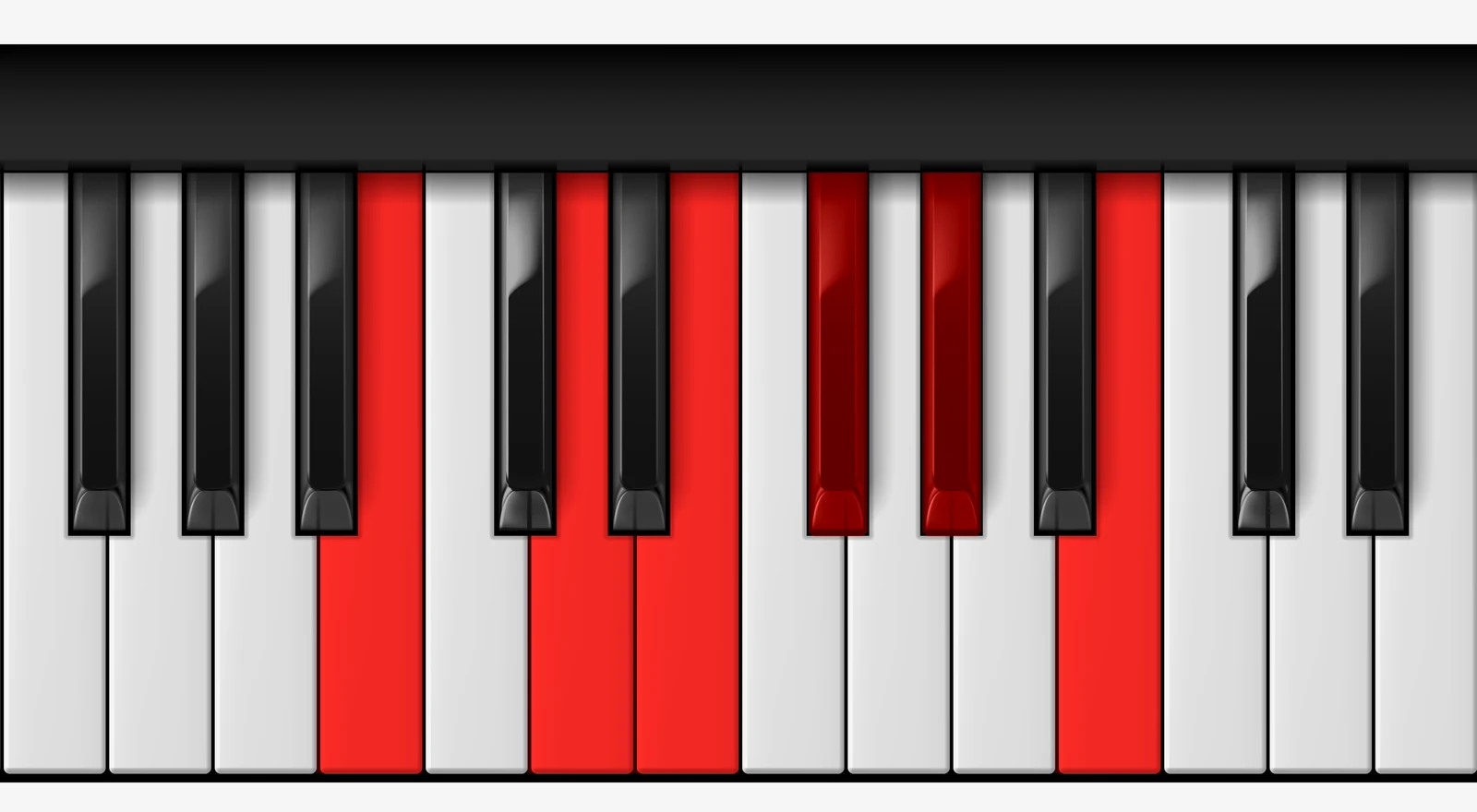
The B Minor 6 Pentatonic Scale shown on a piano keyboard: B, D, E, F#, G#, B.
The B Minor 6 Pentatonic scale contains five notes: B, D, E, F♯, and G♯. It follows the whole-step / half-step pattern m3-W-W-W-m3.
B Minor 6 Pentatonic Scale Notes
Degree
Name
Note
Interval
1
Root
B
P1
♭3
Minor 3rd
D
m3
4
Perfect 4th
E
P4
5
Perfect 5th
F♯
P5
6
Major 6th
G♯
M6
8
Octave
B
P8
Key Signature
The B Minor 6 Pentatonic Scale shares the key signature of its relative major, D Major — 2 sharps (F♯, C♯).
F♯C♯
Written as accidentals
G♯
Order of sharps
Sharps are added to a key signature in a fixed order. Each new sharp key adds the next sharp on the list.
F♯C♯G♯D♯A♯E♯B♯
Mnemonic:Father Charles Goes Down And Ends Battle
Parallel and Relative Keys
Every minor 6 pentatonic scale has two close cousins. The parallel key shares the same root note but flips the mode (major ↔ minor). The relative key shares the exact same notes and key signature, but starts on a different tonic — three semitones up. Both relationships matter for songwriting: borrowing chords from the parallel key adds emotional color, and pivoting to the relative key is a smooth way to change the mood of a section without changing keys on paper.
Parallel key:B Major Scale — same root note (B), opposite mode. The third, sixth, and seventh degrees shift by a half-step. See also the B Major Chord.
Relative key:D Major Scale — same key signature, different tonic. B Minor 6 Pentatonic and D Major use the same seven notes; the difference is which note feels like “home.” See also the D Major Chord.
B Minor 6 Pentatonic Scale — Frequently Asked Questions
What are the notes of the B Minor 6 Pentatonic Scale on piano?
The B Minor 6 Pentatonic Scale uses the notes B – D – E – F♯ – G♯ – B. Play them in order from the root up to the octave, hands separately first, then together.
What notes are in the B Minor 6 Pentatonic Scale?
The B Minor 6 Pentatonic Scale contains five notes: B – D – E – F# – G#. The notes table above shows each note with its scale degree and interval from the root.
How many sharps or flats does B Minor 6 Pentatonic have?
The B Minor 6 Pentatonic Scale shares the key signature of its relative major, D Major — 2 sharps: F♯, C♯. The remaining alterations are written as accidentals: G♯.
What is the relative major of B Minor 6 Pentatonic?
The relative major of B Minor 6 Pentatonic is D Major. Both scales share the same key signature and the same seven notes — the difference is which note feels like "home." Switching between a minor key and its relative major is one of the most common ways composers shift mood without changing the underlying notes.
What chords are in the key of B Minor 6 Pentatonic?
What is the parallel major of B Minor 6 Pentatonic?
The parallel major of B Minor 6 Pentatonic is B Major. "Parallel" means same root note, opposite mode — the two scales differ by three notes (the third, sixth, and seventh are lowered in minor). Borrowing chords from the parallel key is a popular way to add color to a progression.
What does the B Minor 6 Pentatonic Scale sound like?
The B Minor 6 Pentatonic Scale has the foundation of rock, blues, and pop guitar solos — minor without the unstable second and sixth. With only five notes, the pentatonic scale avoids the most dissonant intervals — every note in the scale sounds good against every other, which makes it ideal for soloing.
Keep going with the Minor 6 Pentatonic scale — these pages cover the underlying theory, the connected reference material, and the practice tools that work with this scale.
The note names, intervals, fingering, and harmony on this scale page are grounded in the following sources. Public domain treatises and scores are linked to their full text; primary data reflects piano.org's own interval-derived dataset.