The D♯ Power chord is a two-note chord made up of D♯ and A♯. It is built from a root and perfect fifth.
Construction
D♯ Power = Root + Perfect 5th = D♯ · A♯
| Note | Interval | Degree |
|---|---|---|
| D♯ | Root | 1 |
| A♯ | Perfect 5th | 5 |
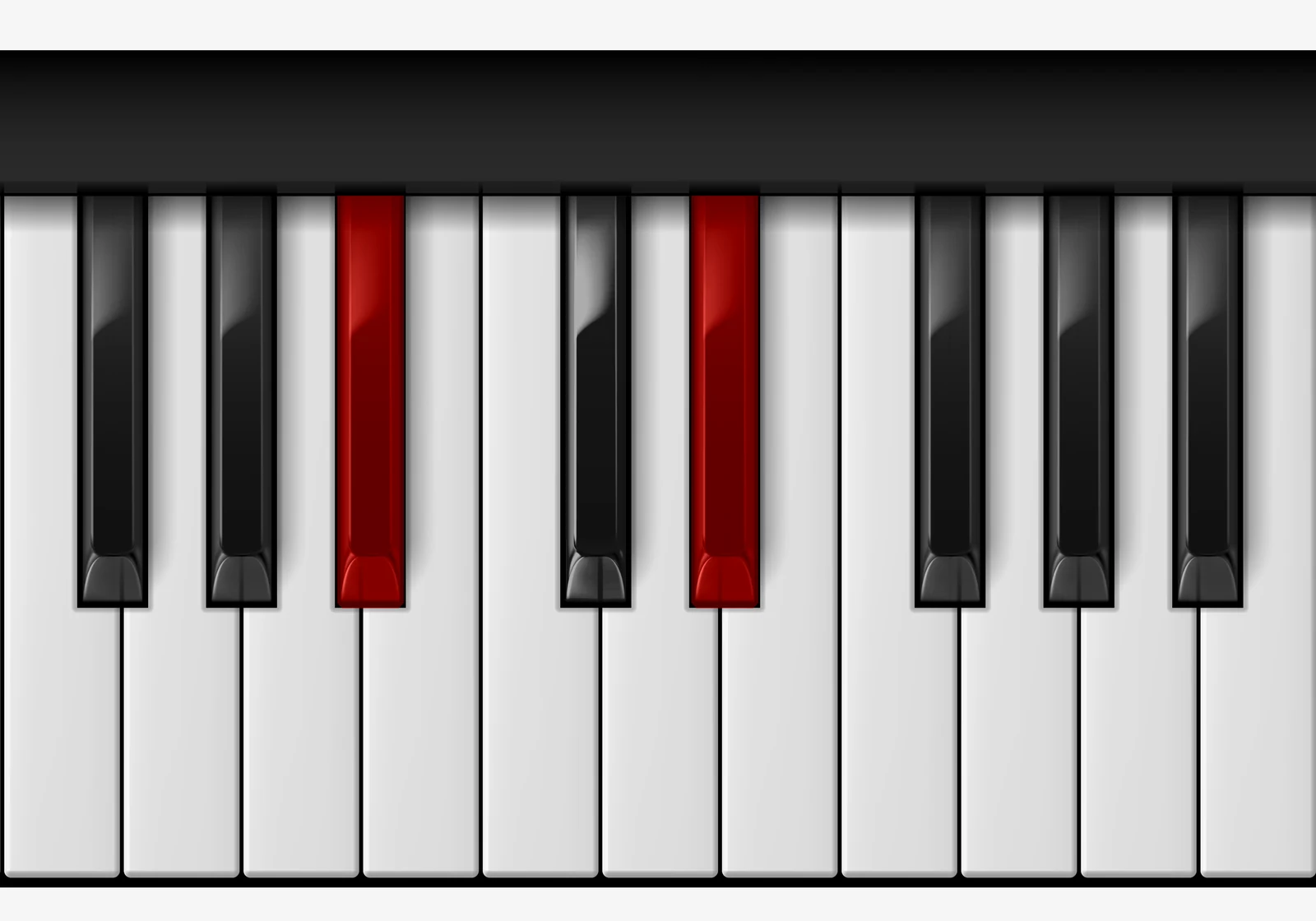
D♯ Power Inversions
| Position | Notes |
|---|---|
| Root Position | D♯ – A♯ |
| 1st Inversion | A♯ – D♯ |
| 2nd Inversion | — |
Key Signature
A chord has no key signature of its own, but the D♯ Power is the tonic (I) chord of D# Major, whose key signature has 3 flats (B♭, E♭, A♭).
B♭E♭A♭
Order of flats
Flats are added in a fixed order — the reverse of the sharp order. Each new flat key adds the next flat on the list.
B♭E♭A♭D♭G♭C♭F♭
Mnemonic: Battle Ends And Down Goes Charles’ Father
Chords in the Key of D♯ Major
These are the triads built on each degree of the D♯ major scale:
D♯ Power — Frequently Asked Questions
What is the D♯ Power chord on piano?
The D♯ Power chord contains the notes D♯ – A♯. On piano, play these notes together to sound the chord.
What notes are in the D# Power chord?
The D# Power chord (D#5) contains 2 notes: D#, A#. Formula: R-P5.
How is D#5 used in music?
D#5 is used in jazz, fusion, and contemporary music to add harmonic color. It appears as a dominant or tonic chord depending on context.
What is the scale degree formula for D#5?
D#5 uses scale degrees 1-5, giving it its distinctive sound.