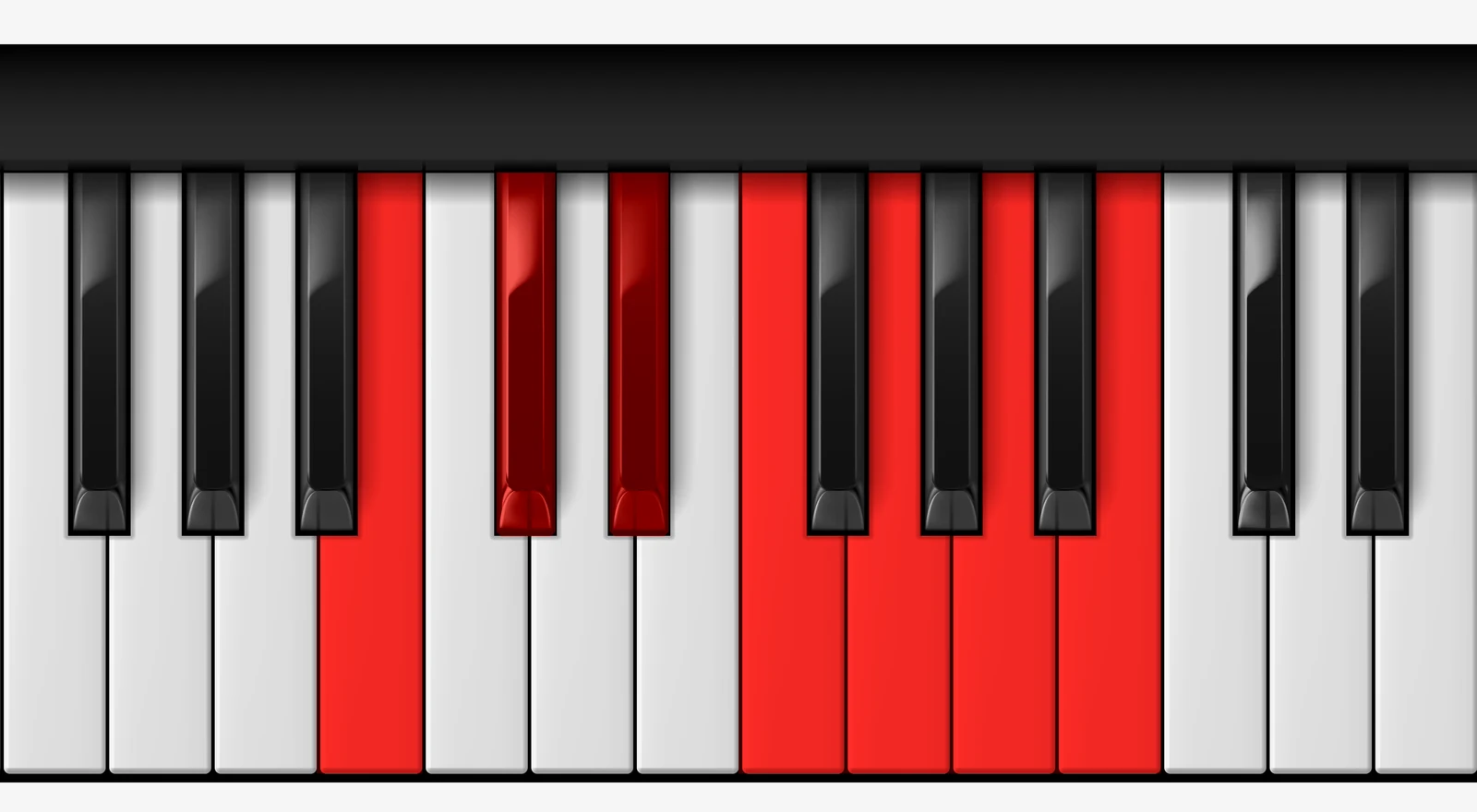
The B Whole Tone Scale shown on a piano keyboard: B, C#, D#, E#, Fx, A, B.
The B Whole Tone scale contains six notes: B, C♯, D♯, E♯, F♯♯, and A. It follows the whole-step / half-step pattern W-W-W-W-W-W.
B Whole Tone Scale Notes
Degree
Name
Note
Interval
1
Root
B
P1
2
Major 2nd
C♯
M2
3
Major 3rd
D♯
M3
♯4
Augmented 4th
E♯
A4
♯5
Augmented 5th
F♯♯
A5
♭7
Minor 7th
A
m7
8
Octave
B
P8
Key Signature
The B Whole Tone Scale doesn’t line up with a single major or minor key, so it has no standard key signature. Its notes are written with accidentals as needed.
Accidentals
C♯D♯E♯F♯♯
B Whole Tone Scale — Frequently Asked Questions
What are the notes of the B Whole Tone Scale on piano?
The B Whole Tone Scale uses the notes B – C♯ – D♯ – E♯ – F♯♯ – A – B. Play them in order from the root up to the octave, hands separately first, then together.
What notes are in the B Whole Tone Scale?
The B Whole Tone Scale contains six notes: B – C# – D# – E# – Fx – A. The notes table above shows each note with its scale degree and interval from the root.
How many sharps or flats does B Whole Tone have?
The B Whole Tone Scale doesn't correspond to a single major or minor key, so it has no standard key signature. Its notes are written with accidentals as needed: C♯, D♯, E♯, F♯♯.
What does the B Whole Tone Scale sound like?
The B Whole Tone Scale has a dreamy, ambiguous quality with no half-steps — used by Debussy and in dream sequences. Listen to the audio playback above to hear the character on every note.
Keep going with the Whole Tone scale — these pages cover the underlying theory, the connected reference material, and the practice tools that work with this scale.
The note names, intervals, fingering, and harmony on this scale page are grounded in the following sources. Public domain treatises and scores are linked to their full text; primary data reflects piano.org's own interval-derived dataset.