G♭ Harmonic Major Scale
Reviewed for accuracy · Last updated June 2026 · Maintained by Justin Evans
Practice G♭ Harmonic Major Scale
Reading about it is one thing. Drilling it is what makes it automatic.
Introduction
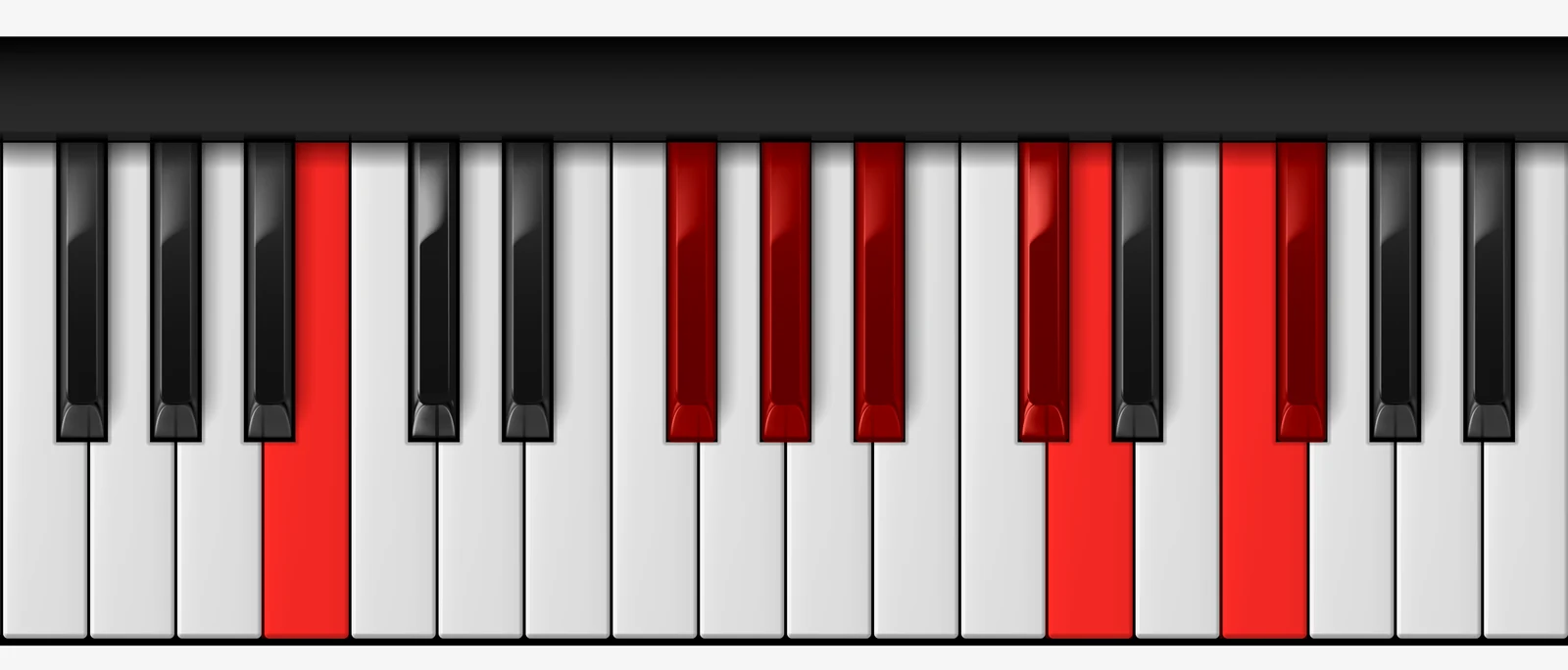
The G♭ Harmonic Major scale contains seven notes: G♭, A♭, B♭, C♭, D♭, E♭♭, and F. It follows the whole-step / half-step pattern W-W-H-W-H-A2-H.
G♭ Harmonic Major Scale Notes
| Degree | Name | Note | Interval |
|---|---|---|---|
| 1 | Tonic | G♭ | P1 |
| 2 | Supertonic | A♭ | M2 |
| 3 | Mediant | B♭ | M3 |
| 4 | Subdominant | C♭ | P4 |
| 5 | Dominant | D♭ | P5 |
| 6 | Submediant | E♭♭ | m6 |
| 7 | Leading Tone | F | M7 |
| 8 | Octave | G♭ | — |
Key Signature
The notes of the G♭ Harmonic Major Scale come from Gb Major, so it carries that key signature: 6 flats (B♭, E♭, A♭, D♭, G♭, C♭).
Written as accidentals
Order of flats
Flats are added in a fixed order — the reverse of the sharp order. Each new flat key adds the next flat on the list.
Mnemonic: Battle Ends And Down Goes Charles’ Father
Diatonic Chords in the G♭ Harmonic Major Scale
These are the triads built on each degree of the G♭ Harmonic Major Scale:
| Degree | Numeral | Chord | Quality |
|---|---|---|---|
| 1 | I | G♭ Major | Major |
| 2 | ii° | A♭ Diminished | Diminished |
| 3 | iii | B♭ Minor | Minor |
| 4 | iv | C♭ Minor | Minor |
| 5 | V | D♭ Major | Major |
| 6 | VI+ | E♭♭ Augmented | Augmented |
| 7 | vii° | F Diminished | Diminished |
G♭ Harmonic Major Scale — Frequently Asked Questions
What are the notes of the G♭ Harmonic Major Scale on piano?
What notes are in the Gb Harmonic Major Scale?
How many sharps or flats does Gb Harmonic Major have?
What is the relative minor of Gb Harmonic Major?
What is the parallel minor of Gb Harmonic Major?
What does the Gb Harmonic Major Scale sound like?
Related Tools
References & Further Reading
How this scale page is sourced & verified
The note names, intervals, fingering, and harmony on this page are drawn from the established body of Western music theory and verified against the conventions below — the same fundamentals taught in conservatories and music programs. We list categories of source material rather than individual titles, and reference the standards themselves rather than any single edition.
- Standard music theory texts — Widely taught fundamentals of pitch, rhythm, and notation.
- Western tonal harmony conventions — Established rules for chord construction, voice leading, and key relationships.
- Interval and chord construction standards — The conventional spelling of intervals, triads, sevenths, and extensions.
- Scale and mode theory — The common derivation of major, minor, pentatonic, blues, and modal scales.
- Piano pedagogy and technique references — Long-standing practices for fingering, hand position, and practice.
Spot something that looks off? Use the note form below — corrections are reviewed by hand.
Leave a note
Spotted a typo, have a question, or want to add something? We read every note.