D Dominant Bebop Scale
Reviewed for accuracy · Last updated June 2026 · Maintained by Justin Evans
Practice D Dominant Bebop Scale
Reading about it is one thing. Drilling it is what makes it automatic.
Introduction
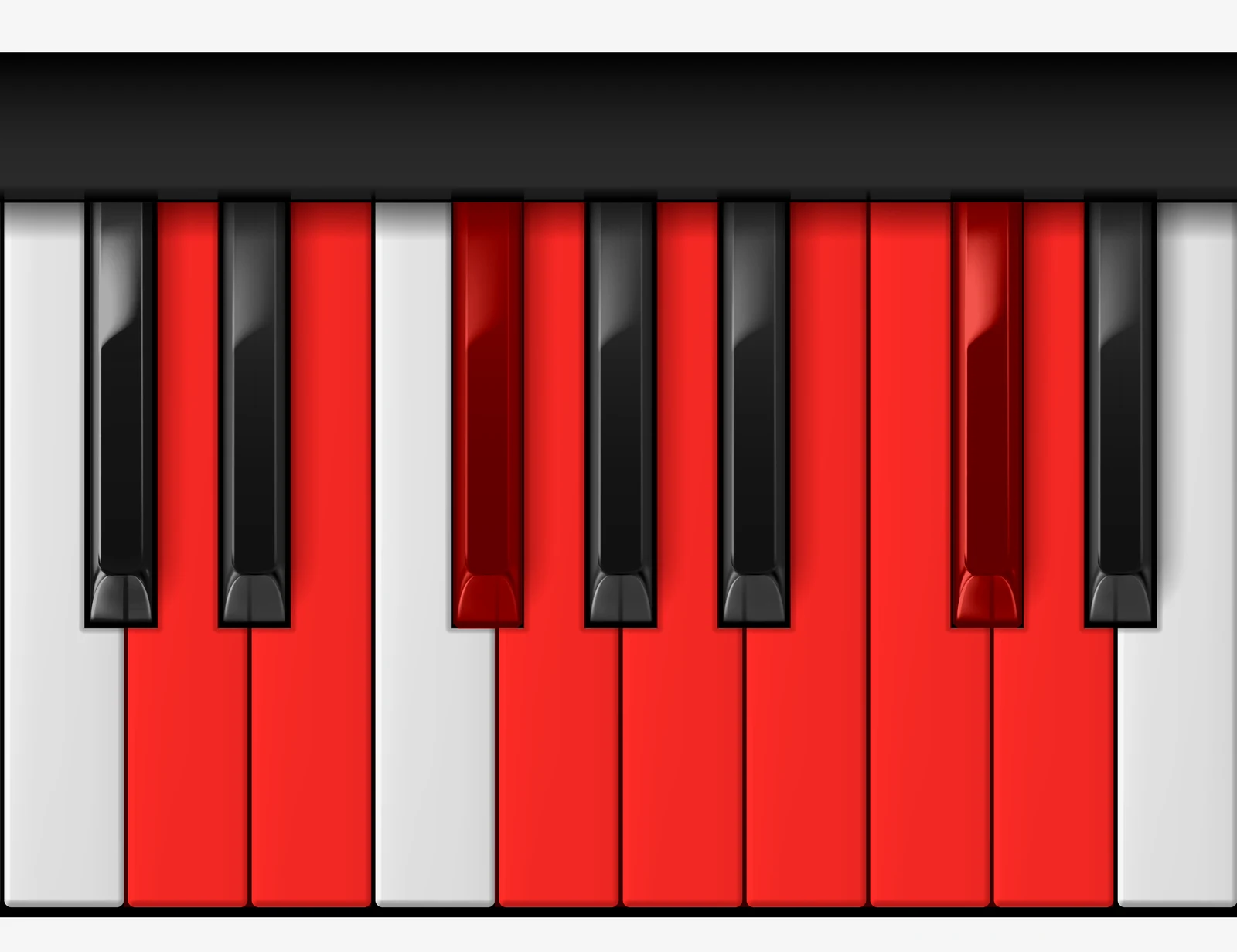
The D Dominant Bebop scale contains eight notes: D, E, F♯, G, A, B, C, and C♯. It follows the whole-step / half-step pattern W-W-H-W-W-H-H-H.
D Dominant Bebop Scale Notes
| Degree | Name | Note | Interval |
|---|---|---|---|
| 1 | Root | D | P1 |
| 2 | Major 2nd | E | M2 |
| 3 | Major 3rd | F♯ | M3 |
| 4 | Perfect 4th | G | P4 |
| 5 | Perfect 5th | A | P5 |
| 6 | Major 6th | B | M6 |
| ♭7 | Minor 7th | C | m7 |
| 7 | Major 7th | C♯ | M7 |
| 8 | Octave | D | P8 |
Key Signature
The D Dominant Bebop Scale doesn’t line up with a single major or minor key, so it has no standard key signature. Its notes are written with accidentals as needed.
Accidentals
D Dominant Bebop Scale — Frequently Asked Questions
What are the notes of the D Dominant Bebop Scale on piano?
What notes are in the D Dominant Bebop Scale?
How many sharps or flats does D Dominant Bebop have?
What does the D Dominant Bebop Scale sound like?
Related Tools
References & Further Reading
How this scale page is sourced & verified
The note names, intervals, fingering, and harmony on this page are drawn from the established body of Western music theory and verified against the conventions below — the same fundamentals taught in conservatories and music programs. We list categories of source material rather than individual titles, and reference the standards themselves rather than any single edition.
- Standard music theory texts — Widely taught fundamentals of pitch, rhythm, and notation.
- Western tonal harmony conventions — Established rules for chord construction, voice leading, and key relationships.
- Interval and chord construction standards — The conventional spelling of intervals, triads, sevenths, and extensions.
- Scale and mode theory — The common derivation of major, minor, pentatonic, blues, and modal scales.
- Piano pedagogy and technique references — Long-standing practices for fingering, hand position, and practice.
Spot something that looks off? Use the note form below — corrections are reviewed by hand.
Leave a note
Spotted a typo, have a question, or want to add something? We read every note.