A Major Pentatonic Scale
A – B – C♯ – E – F♯ – A
Formula:W-W-W+H-W-W+H
Intervals:P1-M2-M3-P5-M6
Introduction
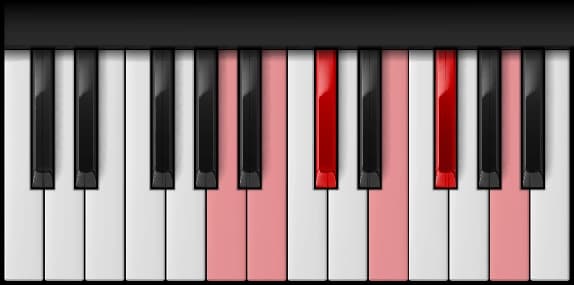
The A major pentatonic scale uses five notes: A, B, C♯, E, and F♯ — the 1st, 2nd, 3rd, 5th, and 6th degrees of the A major scale.
A Major Pentatonic Scale Notes
| Degree | Name | Note | Interval |
|---|---|---|---|
| 1 | Tonic | A | P1 |
| 2 | Supertonic | A | M2 |
| 3 | Mediant | B | M3 |
| 4 | Subdominant | C♯ | P5 |
| 5 | Dominant | E | M6 |
| 6 | Submediant | F♯ | — |
Key Signature
The key of A Major Pentatonic has 3 sharps.
F♯C♯G♯
Order of sharps
Sharps are added to a key signature in a fixed order. Each new sharp key adds the next sharp on the list.
F♯C♯G♯D♯A♯E♯B♯
Mnemonic: Father Charles Goes Down And Ends Battle
Chords in the Key of A Major Pentatonic Scale
These are the diatonic triads built on each degree of the A Major Pentatonic Scale:
C
D
E
F
G
A
B
C
D
E
F
G
A
B
I — A Major (major)
A Major Pentatonic Scale — Frequently Asked Questions
What notes are in the A Major Pentatonic Scale?
The A Major Pentatonic Scale has five notes: A B C# E F# (plus the octave). It omits the 4th and 7th of the A Major scale, leaving degrees 1-2-3-5-6. With no half steps, it has a bright, open sound.
How does the A Major Pentatonic Scale differ from the A Major Scale?
The A Major Pentatonic Scale removes the 4th and 7th scale degrees from A Major. This eliminates all half steps, making every note fit smoothly over I, IV, and V chords in A Major without tension.
What is the fingering for the A Major Pentatonic Scale?
Right hand: 12312345. Left hand: 54321321. Five-note pentatonic scales have fewer thumb crossings than 7-note scales. Practice each hand slowly and separately before combining.
What music uses the A Major Pentatonic Scale?
Major pentatonic scales appear in folk, country, blues, pop, and world music. The A Major Pentatonic Scale is ideal for improvisation and melody writing in A Major — every note sounds good over I, IV, and V chords.
What is the relationship between A Major Pentatonic and A Minor Pentatonic?
They share no notes but are parallel pentatonics — both rooted on A but with different intervals. The major version (degrees 1-2-3-5-6) is brighter; the minor version (degrees 1-b3-4-5-b7) is darker and more bluesy.
Can I use the A Major Pentatonic Scale for improvisation?
Yes — major pentatonics are among the most beginner-friendly improvisation tools. Every note works over I, IV, and V chords in A Major. Start slowly with 3-4 note phrases over a simple chord loop.
Practice Tips
- Play A with just the right hand, one octave, very slowly — notice there are no half steps, giving it that open, bright quality.
- Memorise the 5-note shape: A–B–C#–E–F#–A. Know it before focusing on fingering.
- Loop the scale — go up one octave and immediately back down without stopping, keeping steady pulse.
- Improvise using just 3-4 notes at a time over a simple A Major chord, leaving space between phrases.
- Practice in contrary motion with both hands moving outward from the centre simultaneously.
- Connect to the chord: play A Major chord first, then the pentatonic scale above it to hear how they fit.