The C major scale is the starting point of Western music theory. Seven notes played on the white keys from C to C, with no sharps or flats, it defines the sound of the major mode and the reference every other key is measured against.
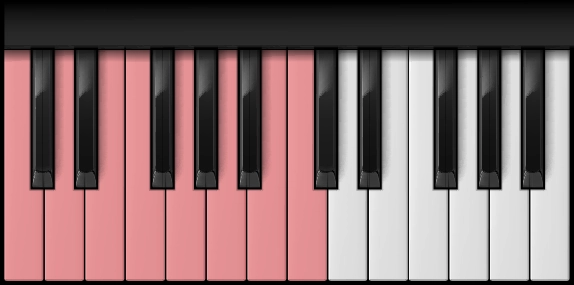
The notes
The major scale follows a fixed pattern of whole and half steps: whole, whole, half, whole, whole, whole, half. Starting on C, that pattern lands exactly on the white keys, which is why C major is usually taught first.
| Note | Degree | Scale degree name |
|---|---|---|
| C | 1 | Tonic |
| D | 2 | Supertonic |
| E | 3 | Mediant |
| F | 4 | Subdominant |
| G | 5 | Dominant |
| A | 6 | Submediant |
| B | 7 | Leading tone |
On the staff
The same seven notes written in standard notation on the grand staff. Toggle the clef to read it in the treble or bass.
How to play it
Right hand, ascending: thumb on C, then 2 on D and 3 on E, tuck the thumb under to reach F, then 2-3-4-5 up to B and C. Left hand mirrors it in reverse fingering. Practice hands separately first, keeping the thumb tuck smooth so there is no bump between E and F.
Key signature and relatives
C major has an empty key signature: no sharps, no flats. Its relative minor is A minor, which shares the same seven notes starting on A. Its parallel minor is C minor, which flattens the third, sixth and seventh.
Chords in the key
Harmonising each scale degree with thirds gives the seven diatonic triads: C (I), D minor (ii), E minor (iii), F (IV), G (V), A minor (vi) and B diminished (vii). These are the chords you can build and play entirely on the white keys.